SHIPPED · REBUILT · 2026
FRC Rebuilt - Steel Hawks
My last FRC robot.
- CAN
- Java
- Electrical
- CAD
- JavaScript
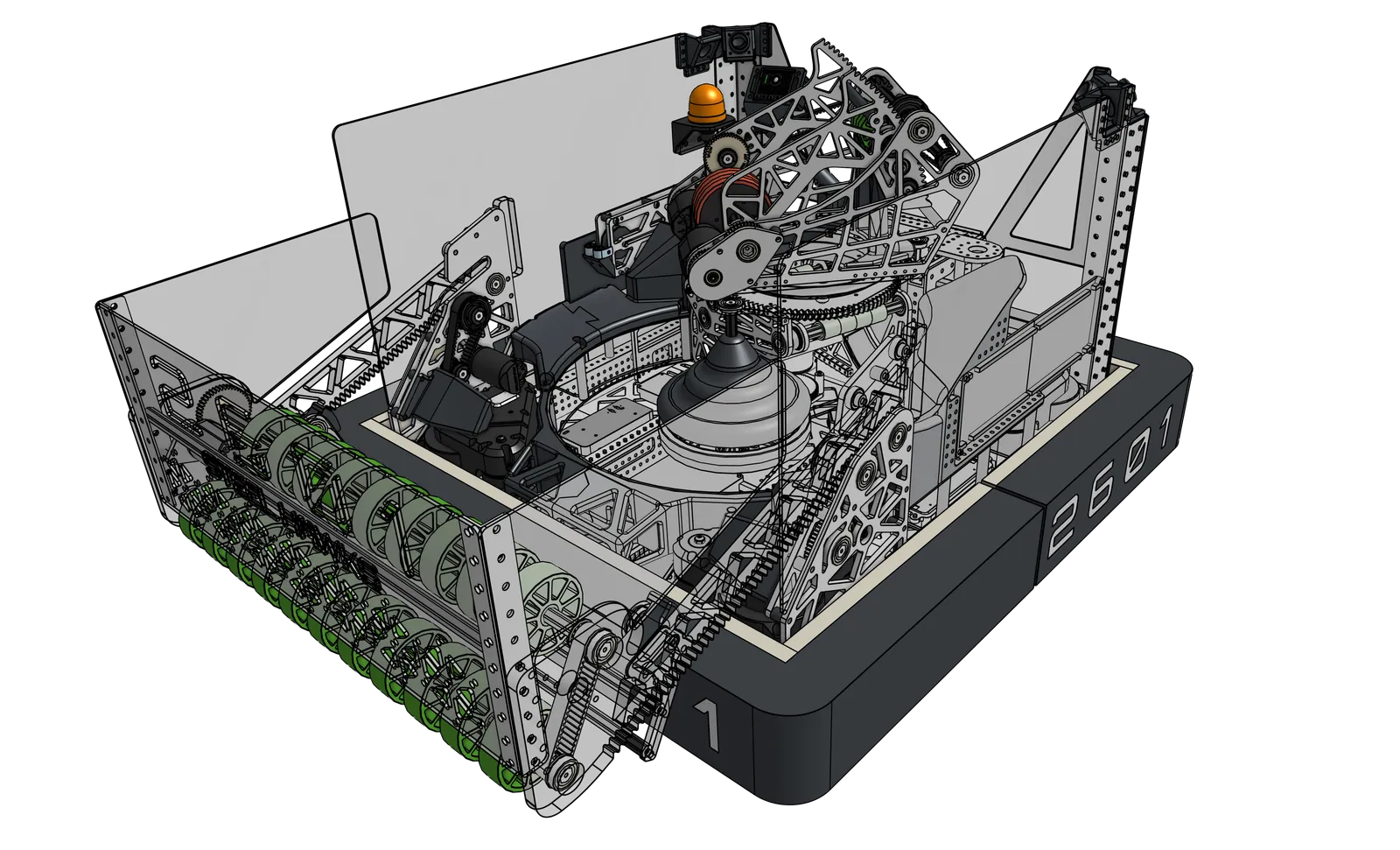
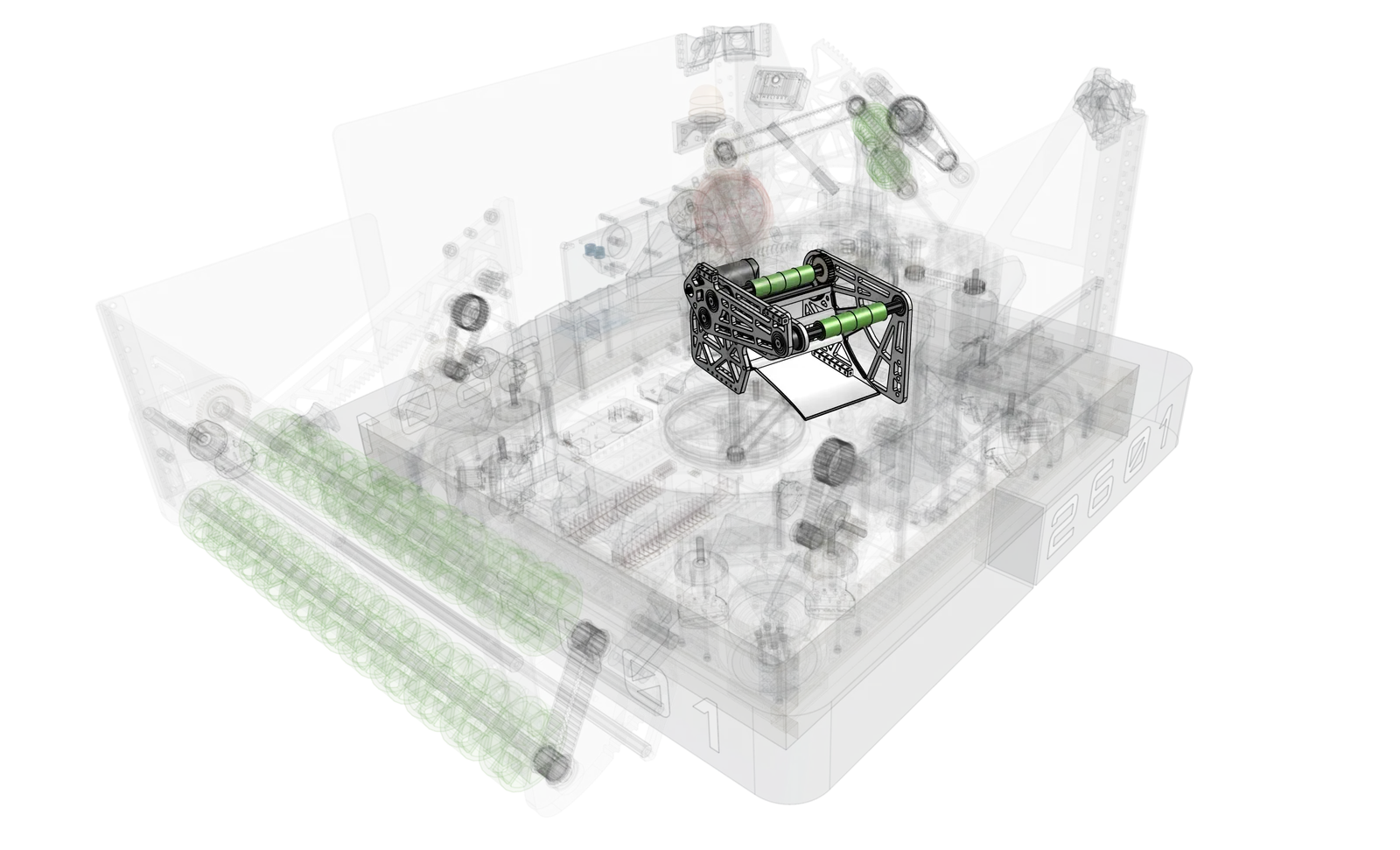
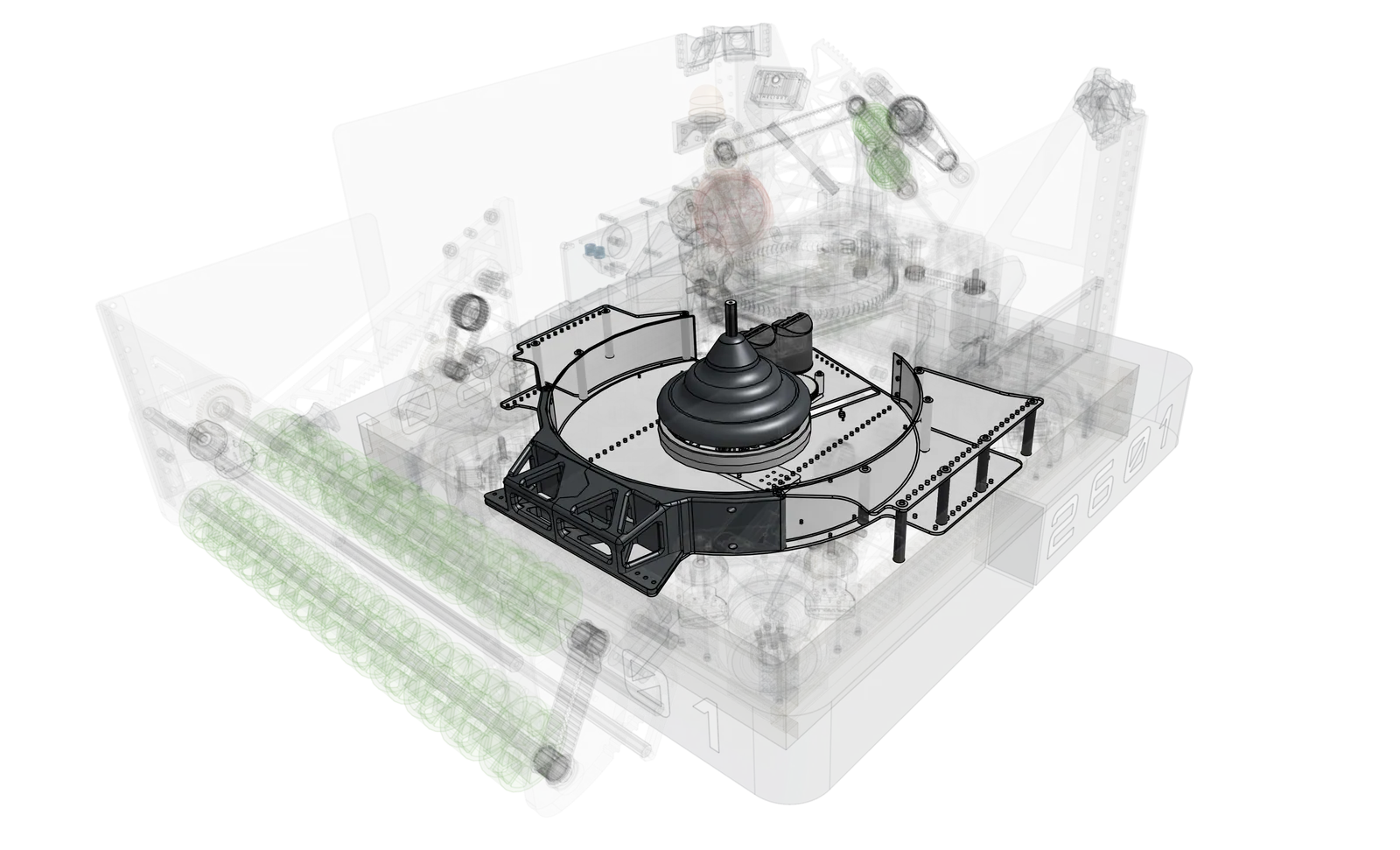
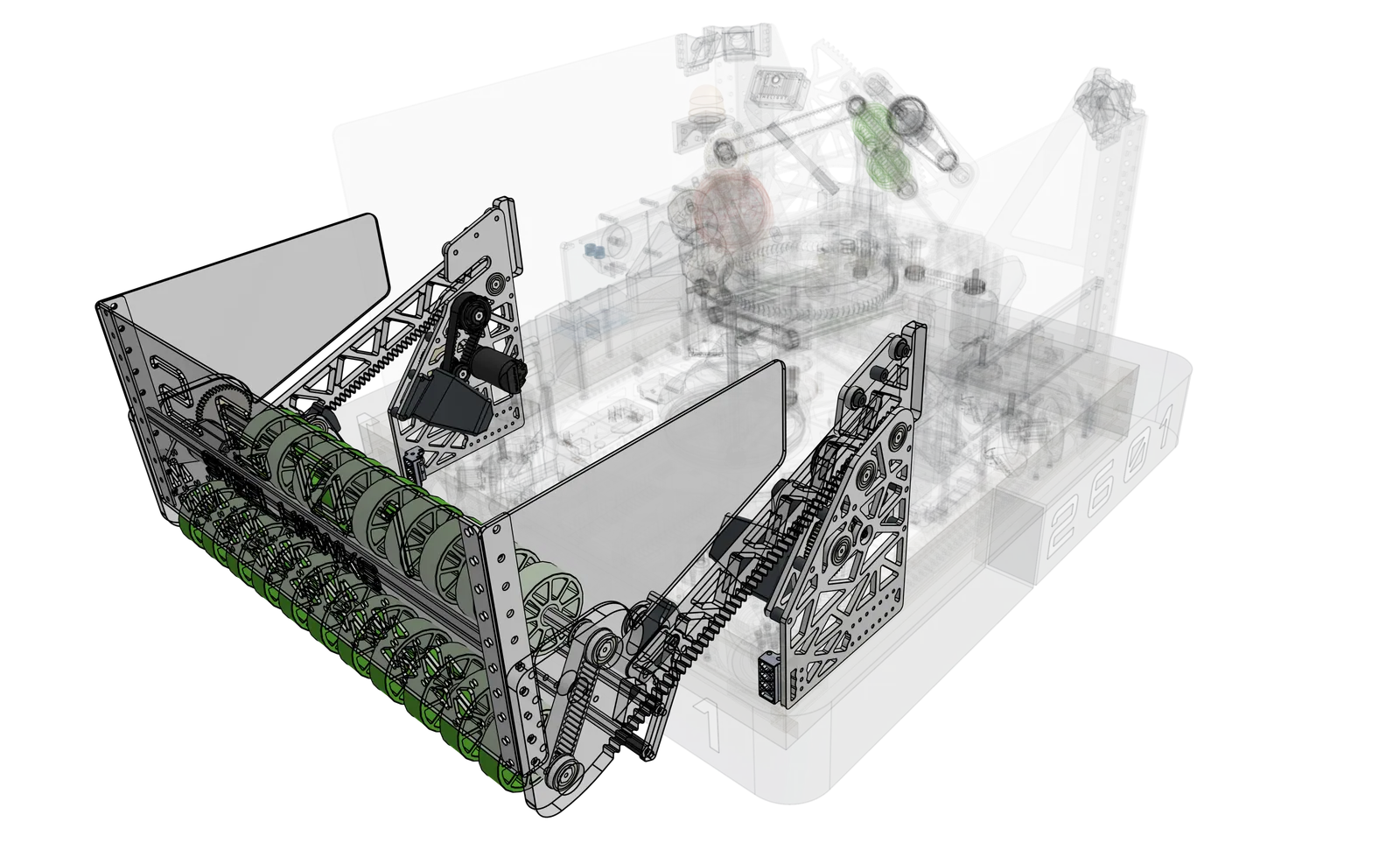
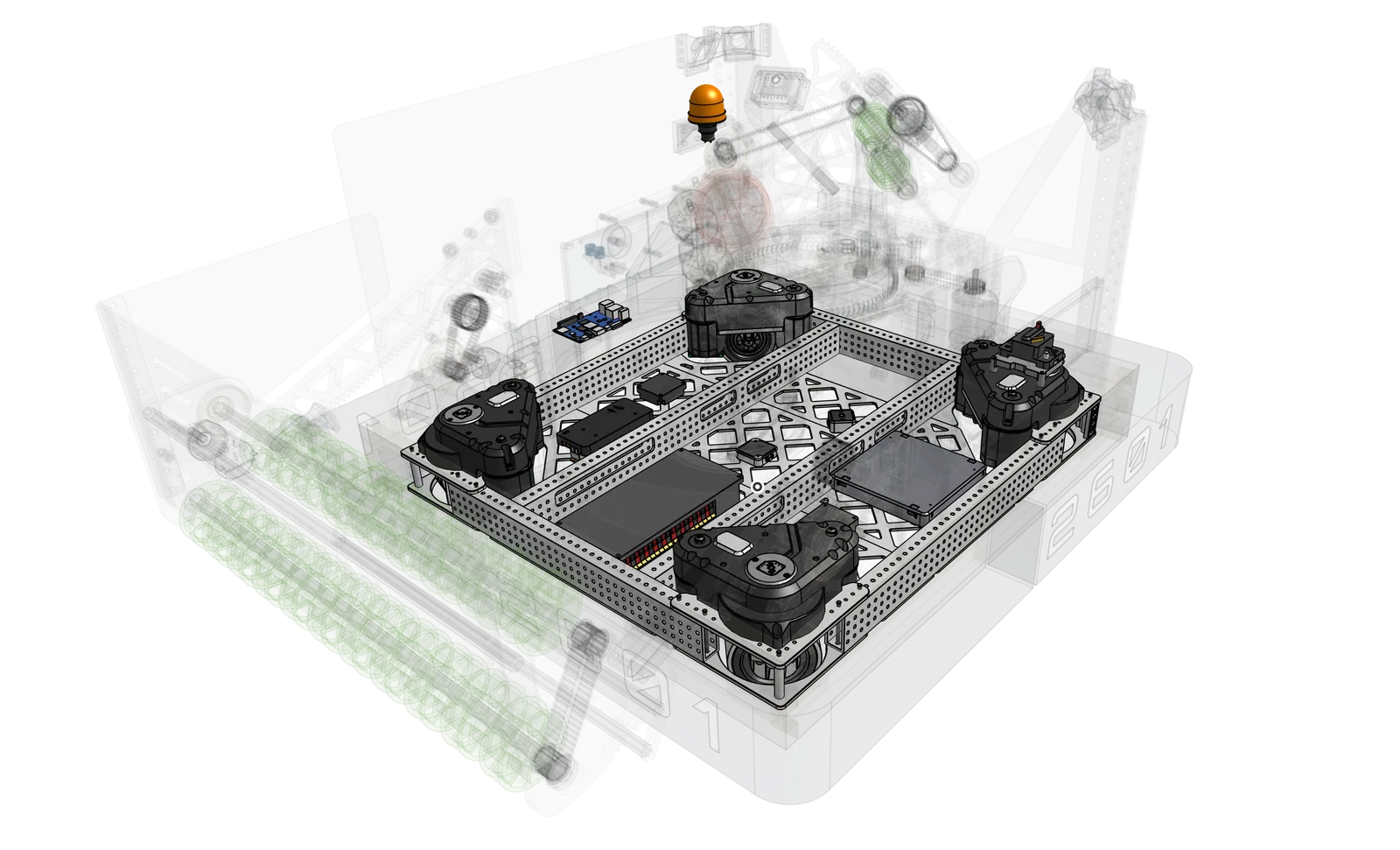
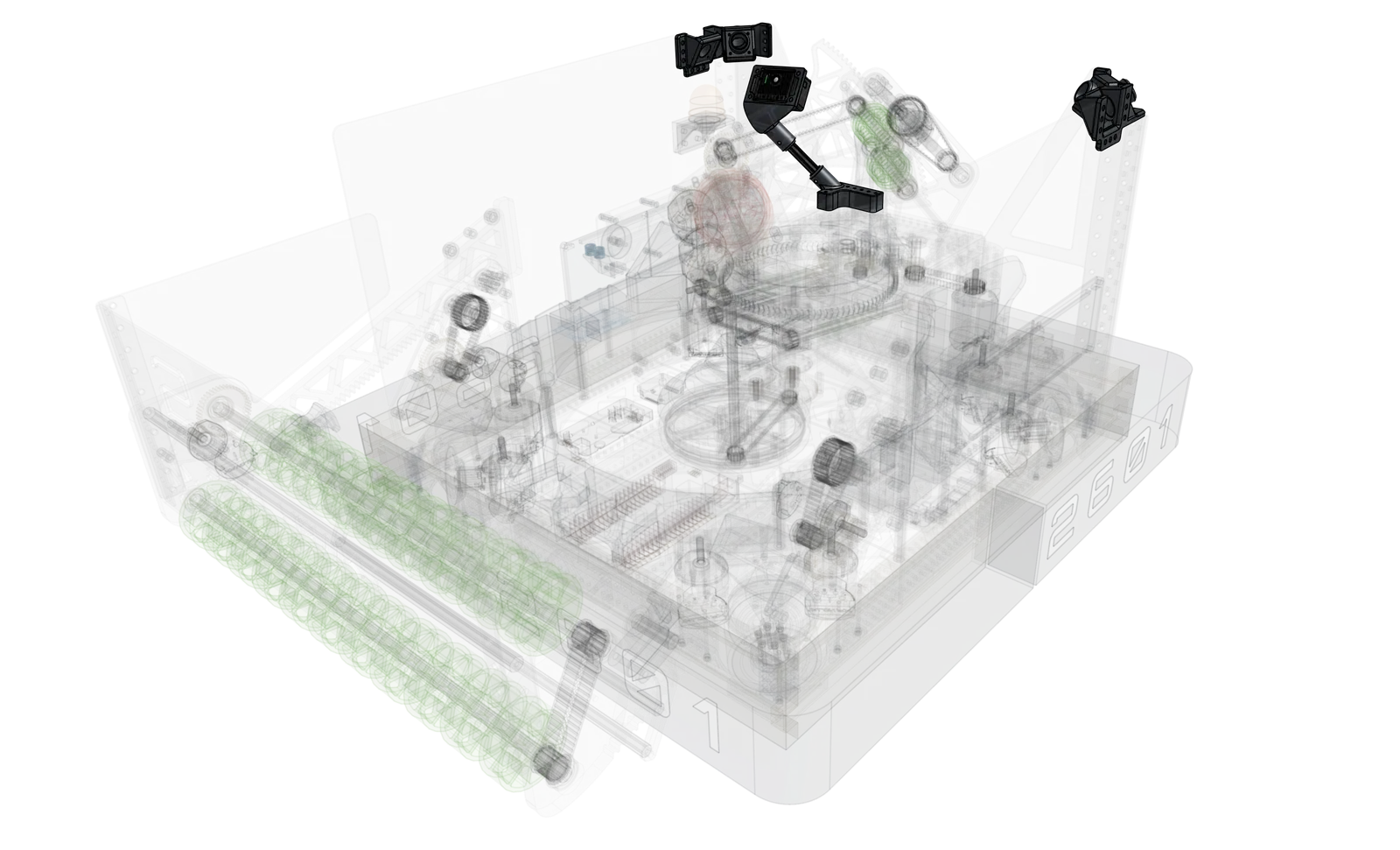
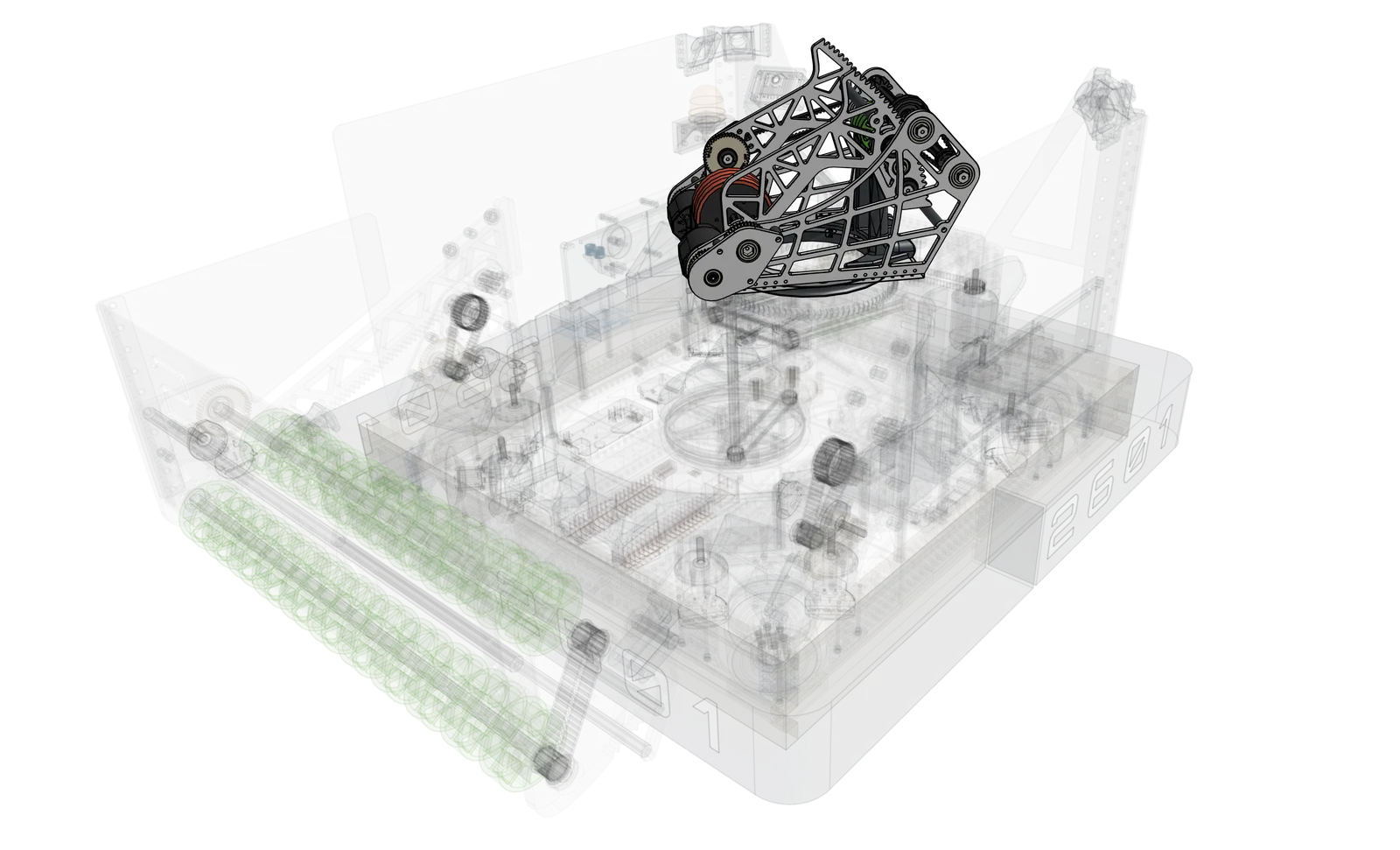
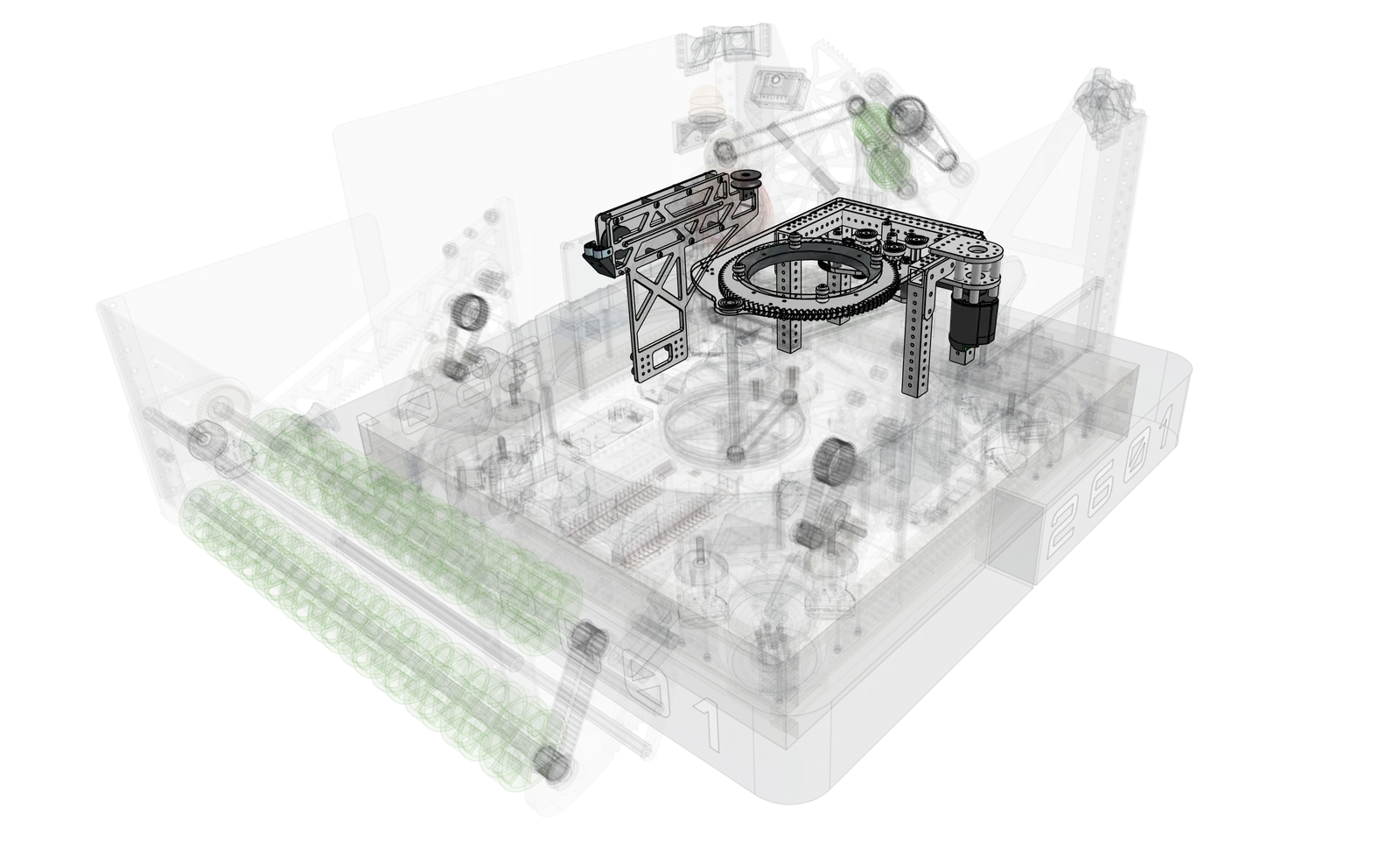
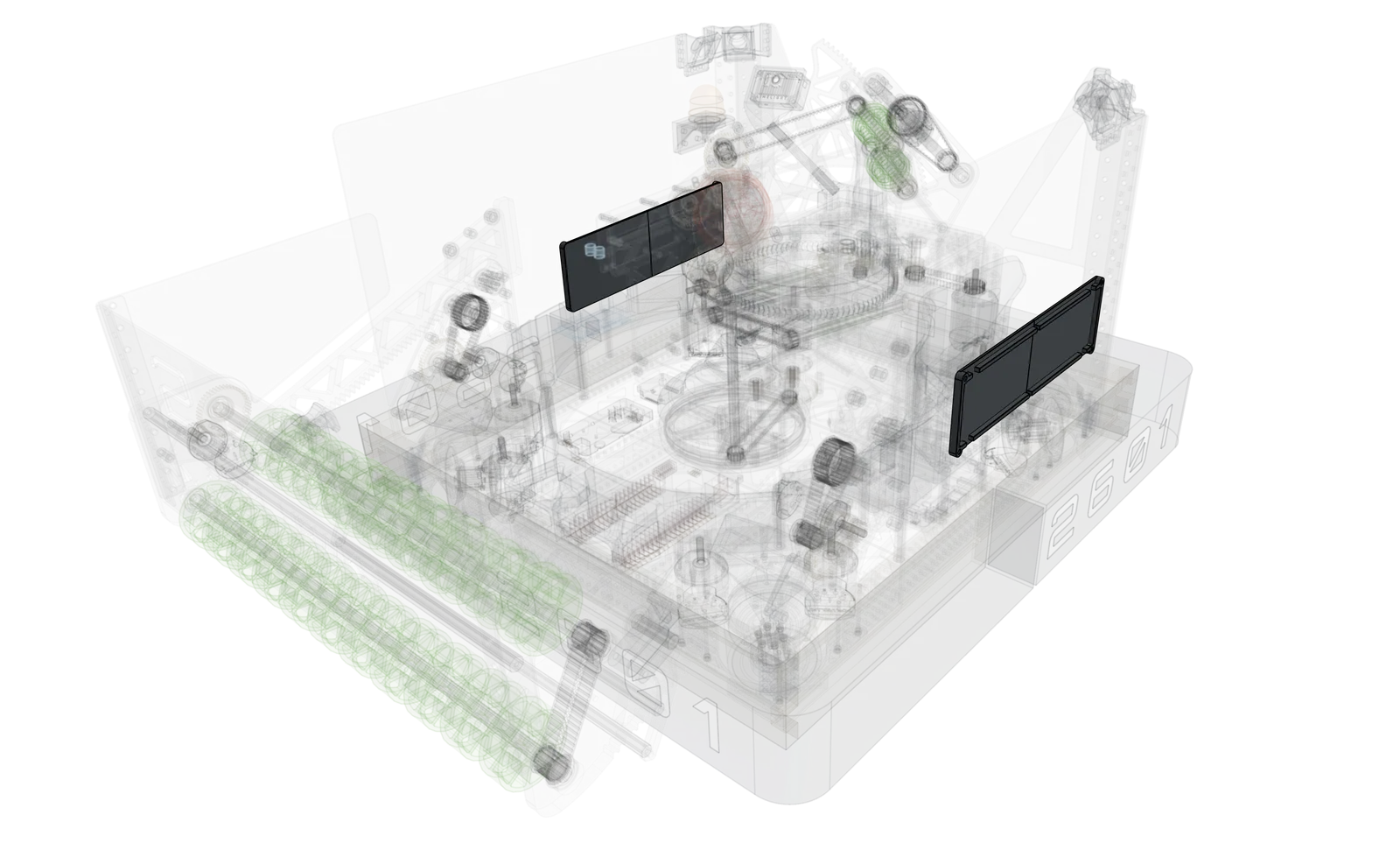
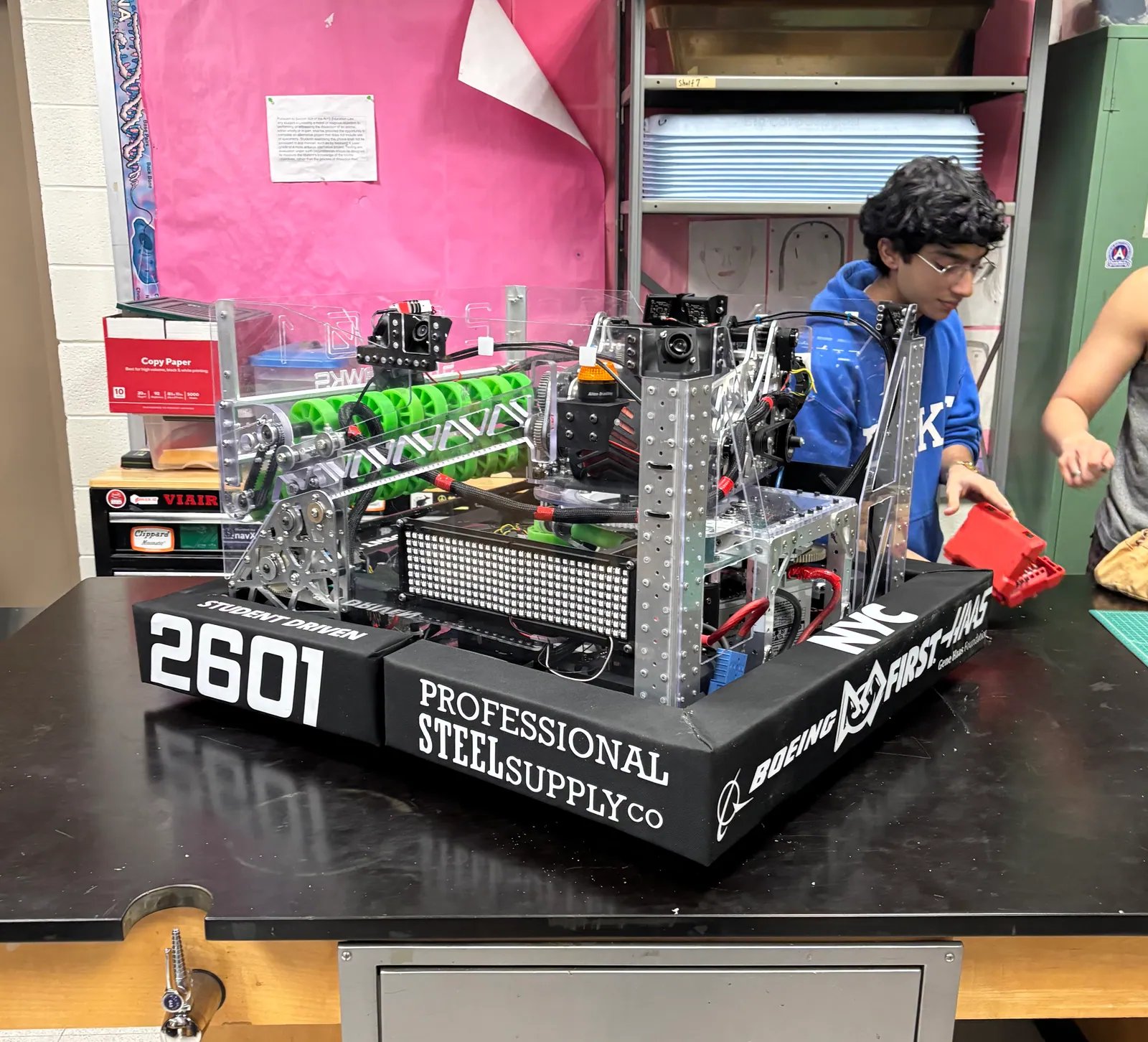 Our robot before I took it home to program before Hudson Valley Regional
background
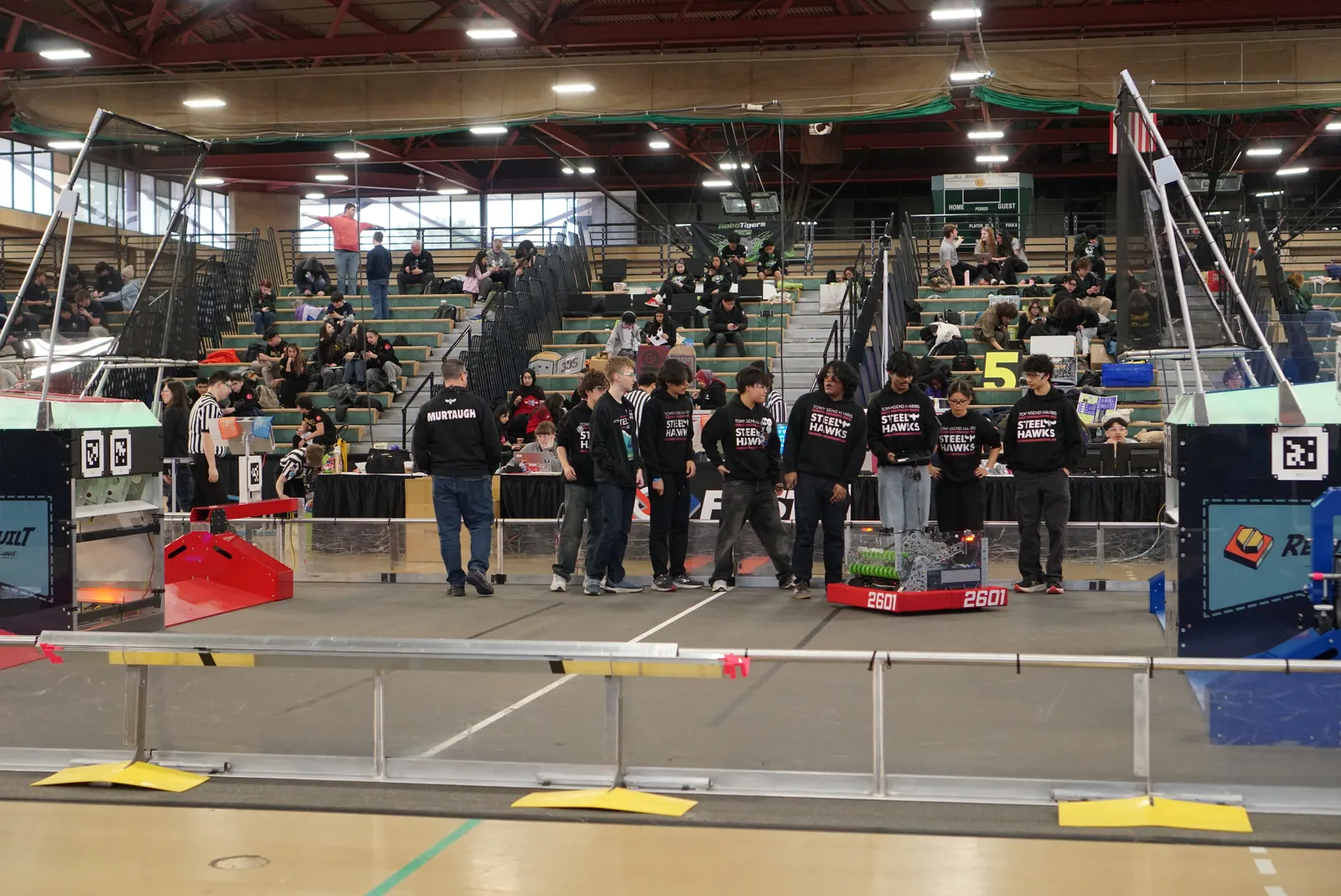
Shaquille O’Steel is Steel Hawks’ 2026 competition robot — it is the last robot I worked on as a student. It is composed of multiple subsystems as seen above, and each subsystem brought unique programmatic challenges to be solved. The most in-depth subsystem is the turret-shooter assembly, requiring the robot to track and hit a target while both the robot and the target’s effective position are constantly shifting — a capability known as shoot-on-the-move (SOTM). Rather than aiming at the hub directly, the turret computes a virtual target that accounts for the robot’s current velocity, letting it lead the shot the same way an anti-aircraft gunner leads a moving plane. This meant the turret’s tracking had to stay fast and precise across the entire rotation range.
sotm
Standing still and shooting into the hub is the easy case. The moment the drivetrain is moving, the ball still leaves the flywheel carrying whatever velocity the robot had — so aiming at the real hub just misses, by more the faster you’re going. The turret doesn’t aim at the hub. It aims at a virtual target: the hub’s position pushed backward along the robot’s velocity by however long the shot will be in the air, so the ball and the hub arrive at the same point at the same time.
The annoying part is that “how long the shot will be in the air” depends on how far away the
virtual target is, and the virtual target’s position depends on how long the shot will be in the
air. It’s circular. RobotState.updateMovingShot() runs every loop and hands off to
ShooterStructure.Moving.solveMovingShot(), which resolves that circularity with Newton’s
method instead of trying to solve it in closed form:
double tGuess = calculateTimeOfFlight(v, theta, virtualDist, deltaH, !isFerry) * tofScale;
for (int i = 0; i < maxIterations; i++) {
    double dragC = Constants.SOTMConstants.DRAG_COEFFICIENT.get();
    double driftTOF = dragC > 1e-6
        ? (1.0 - Math.exp(-dragC * tGuess)) / dragC
        : tGuess;
    double tofOffsetX = -velX * driftTOF - accelX * D * tGuess;
    double tofOffsetY = -velY * driftTOF - accelY * D * tGuess;
    virtualTarget = new Translation3d(
        actualTarget.getX() + posOffsetX + tofOffsetX,
        actualTarget.getY() + posOffsetY + tofOffsetY,
        actualTarget.getZ());

    // recompute distance -> new shot solution -> new TOF guess, then take
    // a Newton step on f(t) = LUT(d(t)) - t using a central finite difference
    // for f'(t) instead of just fixed-point iterating
    ...
    double nextTof = tGuess - f / fPrime;
    tGuess = MathUtil.clamp(nextTof, 0.05, 2.0);
    if (Math.abs(nextTof - tGuess) < timeTolerance) break;
}
driftTOF is where drag actually enters the model. Without air resistance the ball’s
displacement over the flight is just velocity * time. With drag it’s
(1 - e^(-c*t)) / c — the ball’s effective velocity decays exponentially instead of
staying constant, so a constant-velocity model overshoots how far the ball actually
carries on longer shots. In practice this converges in one or two iterations
(SOTM/ConvergedIterations in the logs), so calling it “solving a differential equation
every loop” would be dramatic — it’s a couple of Newton steps and it’s done.
The velocity fed into that solver isn’t just chassis velocity either. The turret is offset from the robot’s center, so when the robot rotates, the turret itself is moving on an arc even if the chassis center is translating slowly:
double turretDx = RobotConstants.ROBOT_TO_TURRET.getX();
double turretDy = RobotConstants.ROBOT_TO_TURRET.getY();
Translation2d fieldRelativeVelocity =
    new Translation2d(
        robotVelocity.getX() + (-chassisOmegaRadPerSec * turretDy),
        robotVelocity.getY() + (chassisOmegaRadPerSec * turretDx))
    .rotateBy(robotHeading);
That’s just v = v_chassis + ω × r for the turret’s mount point, rotated into field frame. Skip this term and the turret undershoots the lead angle on any shot where the robot is turning while it moves, which is most of them.
Acceleration mattered too — a robot accelerating out of a defended position needs a different lead than one at constant velocity, and RobotState picks its acceleration source based on what’s actually available that loop:
Translation2d rawAccel = null;
String accelSource;
if (gyroBodyAccelValid) {
    rawAccel = gyroBodyLinearAccelMps2.rotateBy(getRotation());
    accelSource = "Pigeon";
} else if (previousFieldVelocityTimestampSec > 0.0 && dt > 1e-4 && dt < 0.1) {
    rawAccel = currentFieldVelocity.minus(previousFieldVelocity).div(dt);
    accelSource = "Derivative";
} else {
    accelSource = "Hold";
}
if (rawAccel != null) {
    double tau = Constants.SOTMConstants.ACCEL_LPF_TIME_CONSTANT_SEC.get();
    double effectiveDt = dt > 1e-4 ? dt : Constants.UPDATE_LOOP_DT;
    double alpha = tau > 0.0 ? effectiveDt / (tau + effectiveDt) : 1.0;
    filteredFieldAcceleration =
        filteredFieldAcceleration.times(1.0 - alpha).plus(rawAccel.times(alpha));
}
previousFieldVelocity = currentFieldVelocity;
previousFieldVelocityTimestampSec = now;
Logger.recordOutput("SOTM/FieldAccelEstimate", filteredFieldAcceleration);
Logger.recordOutput("SOTM/AccelSource", accelSource);
Pigeon accel is preferred when it’s valid because it measures the robot’s actual body acceleration — including things like getting hit by another robot — with about a millisecond of latency. The velocity derivative only sees motion odometry can resolve, so it lags and gets noisy under defense. Either way the raw value gets run through a low-pass filter before it’s used, since neither source is clean enough to feed straight into a lead calculation frame to frame.
The shot itself — exit velocity and hood angle for a given distance — comes from a generated lookup table rather than a live physics solve, since running the full ballistic solver every 20ms turned out to be less accurate than a table built once from a proper shot-solver with drag, funnel geometry, and slip factor baked in:
public static double calculateTimeOfFlight(double v, double theta, double x, double deltaH, boolean useLutIfEnabled) {
    if (useLutIfEnabled && Toggles.useLUT.get() && !Toggles.useKinematicsTOF.get()) {
        return shootingTimeOfFlightMap.get(MathUtil.clamp(x, minShootDistance, maxShootDistance));
    }
    // fallback: solve 0.5*g*t^2 - v*sin(theta)*t + deltaH = 0 directly
    ...
}
There’s also a useKinematicsTOF and useLUT toggle pair, so during tuning we could flip between the table and the raw kinematic solve live over NetworkTables and watch how much they diverged, without redeploying code.
(Widget above: drag the arrow to give the robot velocity and watch the virtual target slide off the hub — pulled from the actual shot table, not illustrative numbers.)
turret tracking
SOTM gives the turret a target angle every loop, but a PID loop that only reacts to
position error is always a step behind a moving target — it corrects error after the
error already exists. Turret adds a velocity feedforward so the turret is already
rotating at roughly the rate it needs to be, and the position loop only has to clean up
the remainder:
private double calculateTurretVelocityFF(Translation2d target2d) {
  var turretPos = new Pose3d(robot)
      .transformBy(RobotConstants.ROBOT_TO_TURRET)
      .toPose2d()
      .getTranslation();
  var chassisSpeeds = ChassisSpeeds.fromRobotRelativeSpeeds(
      RobotContainer.s_Swerve.getChassisSpeeds(),
      RobotState.getInstance().getRotation());
  double omegaRobot = chassisSpeeds.omegaRadiansPerSecond;

  // velocity of the turret's mount point = chassis linear velocity + omega x r_offset
  Translation2d robotToTurret = turretPos.minus(robot.getTranslation());
  double turretVx = chassisSpeeds.vxMetersPerSecond - omegaRobot * robotToTurret.getY();
  double turretVy = chassisSpeeds.vyMetersPerSecond + omegaRobot * robotToTurret.getX();
  Translation2d turretVelocity = new Translation2d(turretVx, turretVy);

  Translation2d mrR = target2d.minus(turretPos);
  double distance = mrR.getNorm();
  Translation2d rHatPerpendicular = mrR.div(distance).rotateBy(Rotation2d.kCCW_Pi_2);

  double tangentialVelocity = turretVelocity.dot(rHatPerpendicular);
  return (tangentialVelocity / distance) - omegaRobot;
}
The idea is angular velocity = tangential velocity / radius. Project the turret’s field
velocity onto the direction perpendicular to the line-of-sight, divide by distance to the
target, and that’s how fast the bearing to the target is changing — which is exactly the
rate the turret needs to spin to hold it. Subtracting omegaRobot at the end converts
that from a field-relative rate into a turret-relative one, since the turret’s own frame
is already rotating with the chassis. This runs on the virtual target from SOTM, not
the real hub, so the feedforward and the aim point stay consistent with each other.
There’s a second feedforward that has nothing to do with the target moving at all — the turret sits on a physical counterbalance spring, which fights the control loop differently depending on where the turret is in its range:
double negThreshold = -0.984816 + SPRING_HYSTERESIS;
double posThreshold = 1.810097 - SPRING_HYSTERESIS;

if (pos <= negThreshold) {
    double depth = (negThreshold - pos) / (negThreshold - constants.minRotation().getRadians());
    constantForceSpringFF = constantForceFF.getAsDouble() * Math.min(depth, 1.0);
} else if (pos >= posThreshold) {
    double depth = (pos - posThreshold) / (constants.maxRotation().getRadians() - posThreshold);
    constantForceSpringFF = -constantForceFF.getAsDouble() * Math.min(depth, 1.0);
}
Near the middle of the range the spring’s torque is small enough to ignore. Past a threshold on either side, it ramps in linearly with how far past the threshold the turret is, capped at the spring’s rated force once fully engaged. SPRING_HYSTERESIS keeps the turret from chattering the feedforward on and off if it sits right at the threshold. Both feedforward terms — velocity and spring — get summed and added directly into the MotionMagic call:
io.runPivotMM(
  desiredRotation.getRadians(),
  kV.getAsDouble() * calculateTurretVelocityFF(velocityTargetFF) + constantForceSpringFF
);
shot solver
Everything the LUT feeds into SOTM and the flywheel comes out of this app, not out of code. The generated table isn’t just distance → speed → hood angle — it’s produced by a solver that already accounts for drag, funnel geometry, and how much the wheel actually slips against the ball versus its ideal surface speed, baked into a single set of generation parameters recorded right alongside the table it produced:
// Generation parameters:
//   placement bias    0.91 (back rim)
//   slip η            0.75
//   ball condition    0.89
//   η × wear          0.667
//   hood angle bias   +0.0°
//   wheel radius      0.0508 m
//   drag              on  (Cd=0.50, m=0.215 kg, d=0.150 m)
placement bias is why the LUT deliberately doesn’t aim for dead-center on the hub — it’s
solved to land at 0.91 of the way toward the back rim on purpose, which is what buys the
shot margin for error before it ever reaches the robot. The same run that generates the
speed/angle/TOF columns also generates the close/far columns behind the flywheel’s
readiness band:
shootingFlywheelVelocityCloseMap.put(1.743, 8.66);
shootingFlywheelVelocityFarMap.put(1.743, 11.11);
So the band isn’t a separate tolerance bolted onto the LUT after the fact — it’s the same
solve, at the same distance, just reporting the full range of wheel speeds that still land
the shot within the placement-bias margin instead of only the single best-fit speed. That’s
the number ShooterStructure.getVelocityBandRatios() reads from at runtime:
public static double[] getVelocityBandRatios(double distance) {
  double target = shootingFlywheelVelocityMap.get(d);
  double close = shootingFlywheelVelocityCloseMap.get(d);
  double far = shootingFlywheelVelocityFarMap.get(d);
  return new double[] {close / target, far / target};
}
It’s expressed as a ratio against the centroid speed rather than an absolute number so it
still scales correctly under any multiplier applied on top at runtime — ferry shots,
auton, the manual redbull speed nudge. Flywheel turns those ratios back into real speeds
for whatever’s actually commanded, and gates readiness on the band instead of a symmetric
tolerance around one number:
double[] ratios = ShooterStructure.getVelocityBandRatios(dist);
if (ratios != null) {
  bandLoRadPerSec = targetVelocityRadPerSec * ratios[0];
  bandHiRadPerSec = targetVelocityRadPerSec * ratios[1];
  rawInBand = avgVelocityRadPerSec >= bandLoRadPerSec && avgVelocityRadPerSec <= bandHiRadPerSec;
}
Practical effect: during spin-up, the moment the wheel crosses into the valid band — often well before it’s actually settled at the commanded setpoint — the shot is live. There’s no reason to wait for a speed the solver already said wasn’t necessary.
The one thing that assumption doesn’t cover for free: the LUT’s time-of-flight column was
generated assuming the ball leaves at exactly the commanded setpoint. Fire early, mid
spin-up, and the ball is a little slower than that, so it’s actually in the air slightly
longer than the LUT says — and SOTM’s lead angle depends directly on that number.
getTofSpeedScale() corrects for it:
public double getTofSpeedScale() {
  double measured = (inputs.leftVelocityRadPerSec + inputs.rightVelocityRadPerSec) / 2.0;
  if (targetVelocityRadPerSec < 1.0 || measured < 1.0) return 1.0;
  return Math.max(0.7, Math.min(1.4, targetVelocityRadPerSec / measured));
}
Setpoint over measured, clamped so a sensor glitch or a stalled wheel can’t send a wild scale factor into the solver. 1.0 once the wheel is settled — the exact condition the LUT was generated for, so it’s a no-op. Above 1.0 when firing below setpoint, which stretches the TOF the Newton solver in solveMovingShot() converges to, so the lead angle stays correct even for a shot taken mid spin-up. The correction on any single shot is small — the whole point of the placement bias is that it doesn’t need to be perfect — but across a full match of shots taken as soon as the band allows instead of waiting for full settle, it’s real cycle time back.
closing thoughts
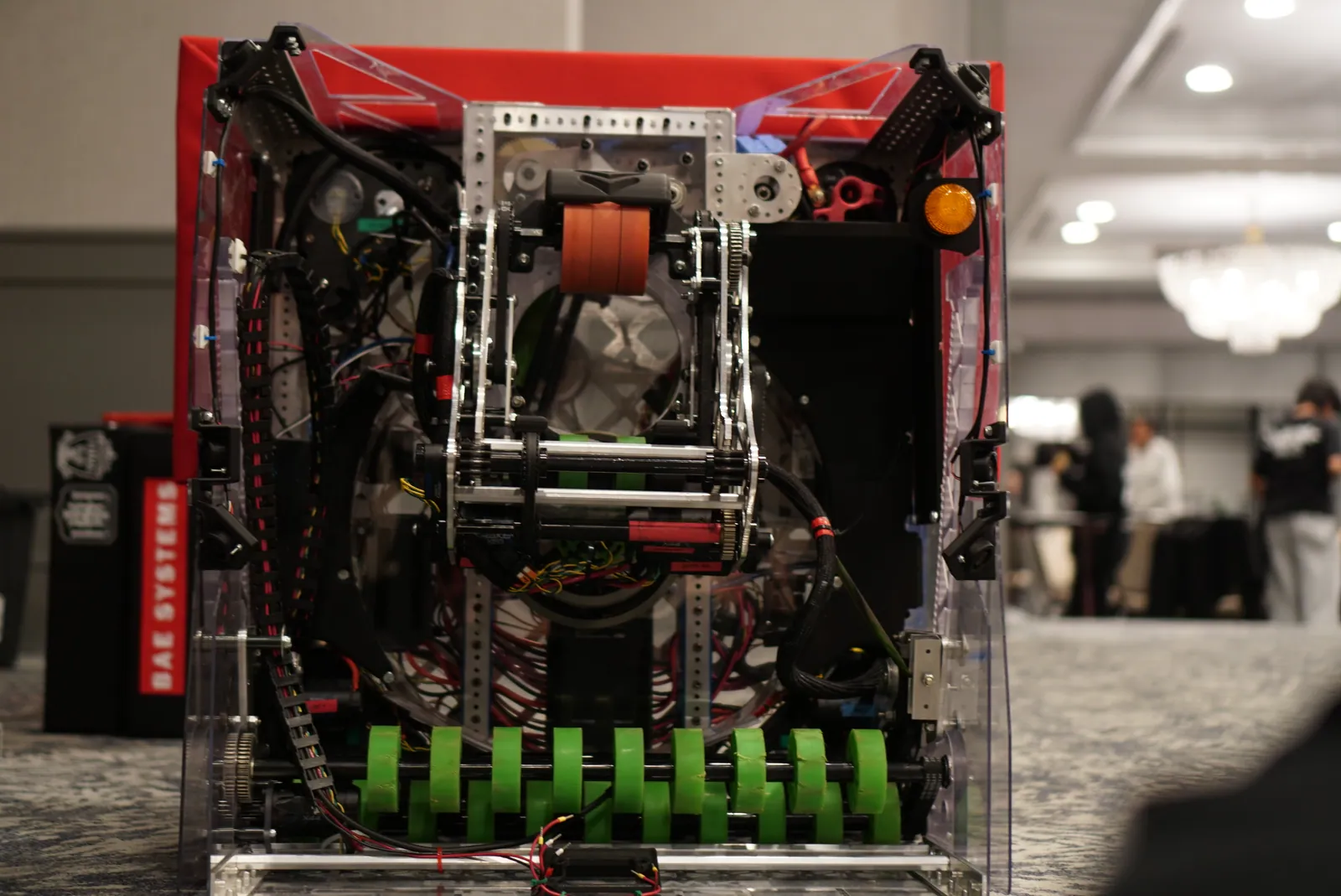 Shaquille O’Steel taken to our hotel before our regional for some last minute testing.