SHIPPED · REEFSCAPE · 2025
FRC Reefscape - Steel Hawks
Chimera: the year we moved to AdvantageKit, and the rewrite of swerve and vision that came with it.
- Java
- AdvantageKit
- Phoenix 6
- PhotonVision
- QuestNav
background
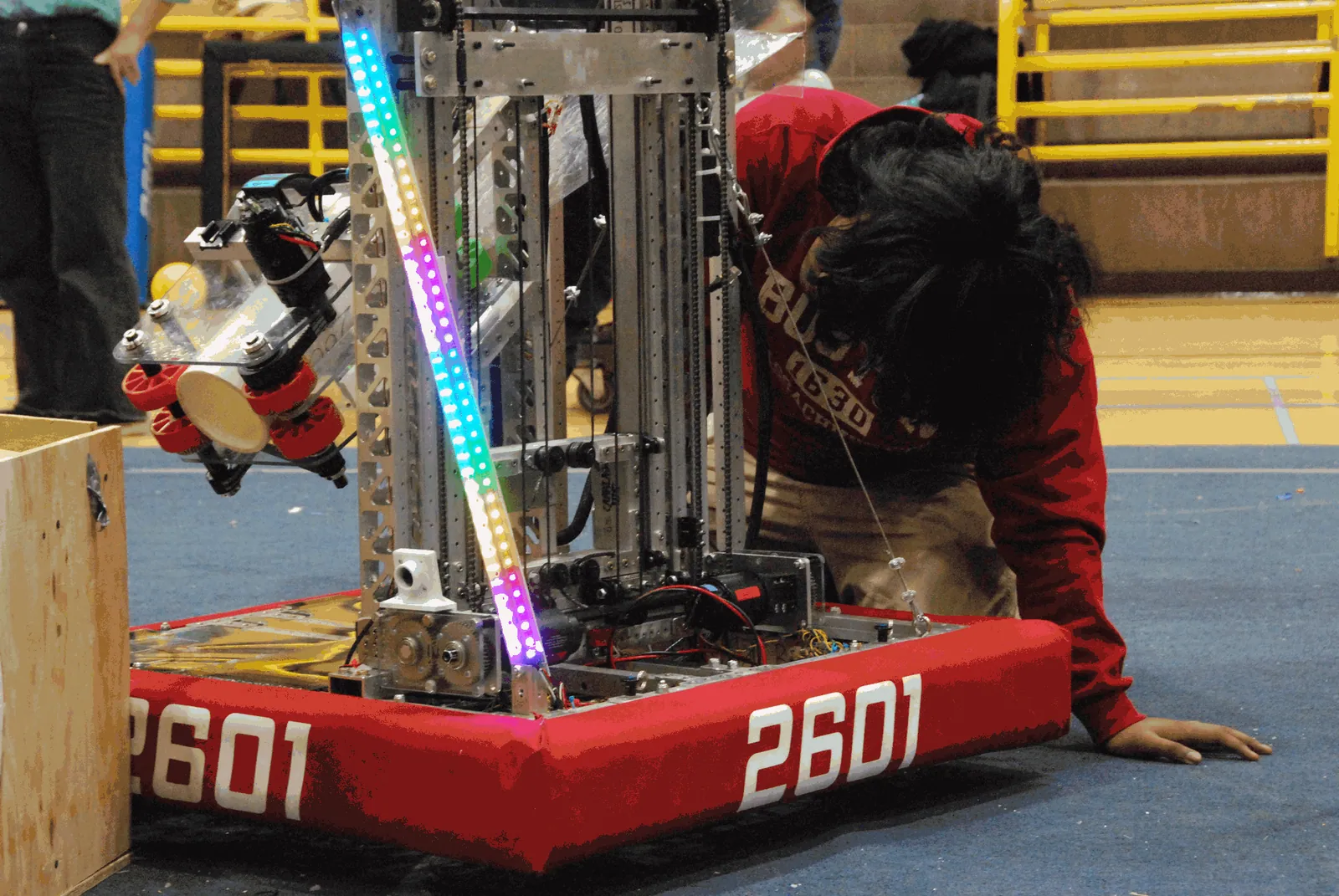
Chimera was Steel Hawks’ robot for REEFSCAPE, the 2025 FRC game: stack coral (lengths of PVC) on the branches of a hexagonal reef at four heights, L1 through L4, and pull algae off it. The robot was an Mk4n swerve on the L3 ratio, a two-motor elevator that could reach every level, a static claw fixed at 35°, an arm for knocking algae off the reef, four PhotonVision cameras, and LEDs for talking to the driver. It played all the way to Worlds; logs from our Archimedes division matches are still sitting in the repo.
I started the repo in January 2025 and ended up writing a bit over half of its ~1,100 commits, running through the offseason into January 2026. The biggest change that year wasn’t a mechanism. It was how the code was structured, and nearly everything else on this page follows from it.
the talk
After the season I presented a lot of this at StuySplash 2025, StuyPulse’s offseason workshop. Let’s Never Miss Again is a programming talk about the systems that let Chimera score the same way every time. It covers elevator interpolation, torque-current FOC, anti-tip, Autopilot alignment, ReefState, and QuestNav. The slides are here.
 StuySplash 2025 · Let's Never Miss Again
advantagekit
Our 2024 code already had AdvantageKit in it, technically. Robot.java started the logger,
and two files called Logger.recordOutput. But the subsystems still owned their hardware
directly. Swerve built its own Pigeon2 and Limelight objects and read from them
wherever it needed to. That means a log could tell you what the robot did, but not what it
saw, and without what it saw there’s nothing to replay.
For 2025 every subsystem got split in two. The subsystem holds the logic, and an IO interface
holds everything that touches hardware. Each loop, the IO layer fills an inputs object with
every sensor reading, and Logger.processInputs records it before the logic runs. The swerve
module’s inputs look like this:
@AutoLog
class ModuleIOInputs {
    public boolean driveConnected = false;
    public double drivePositionRad = 0.0;
    public double driveVelocityRadPerSec = 0.0;
    public double driveAppliedVolts = 0.0;
    public double driveCurrentAmps = 0.0;
    ...
    public double[] odometryTimestamps = new double[]{};
    public double[] odometryDrivePositionsRad = new double[]{};
    public Rotation2d[] odometryTurnPositions = new Rotation2d[]{};
}
Then which implementation gets plugged in decides what the robot is. On the real robot it’s
ElevatorIOTalonFX. In simulation it’s ElevatorIOSim, with the drivetrain running on a
maple-sim physics model. And in replay it’s nothing at all:
if (Constants.getMode() == Mode.REPLAY) {
    s_Swerve =
        new Swerve(
            new GyroIO() {},
            new ModuleIO() {},
            new ModuleIO() {},
            new ModuleIO() {},
            new ModuleIO() {});
    ...
    s_Elevator =
        new Elevator(
            new ElevatorIO() {});
Empty IO layers. In replay the inputs come from the log file instead of hardware, so the exact
same code runs against exactly what the robot saw in a real match, as fast as the laptop can
go. Something went wrong in a qualification match? Add a Logger.recordOutput for the value
you wish you’d logged, replay the match, and now you have it. That’s a completely different way
of debugging from “try to make it happen again in the pit.”
The same split made the codebase portable across robots. One repo ran four of them (the Alpha prototype, Omega (the competition robot), HawkRider from 2024, and the simulator), with constants switched per robot:
public static <T> T value(T hawkrider, T alpha, T omega, T sim) {
    return switch (Constants.getRobot()) {
        case ALPHABOT -> alpha;
        case OMEGABOT -> omega;
        case HAWKRIDER -> hawkrider;
        case SIMBOT -> sim;
    };
}
The catch with deterministic replay is that everything the logic reads has to come through logged inputs. Anything that sneaks in from the side, like a NetworkTables callback on its own thread, breaks it. That’s why this warning sits above the one listener in the codebase:
reefData.addListener(
    // WARNING!!!
    // DO NOT LOG HERE, AdvantageKit is not thread-safe and you will ruin replay
    // https://docs.advantagekit.org/getting-started/common-issues/multithreading
    ...
swerve
I rewrote the swerve on top of that structure. The 2024 modules ran the drive motors on duty cycle and velocity-voltage, and odometry updated once per 20 ms robot loop. The new drivetrain changed both.
Odometry runs on its own thread. PhoenixOdometryThread samples every module’s position
and the gyro at 250 Hz when the bus is CAN FD (100 Hz otherwise), stamping each sample with the
time it was taken:
if (isCANFD && phoenixSignals.length > 0) {
    BaseStatusSignal.waitForAll(2.0 / Swerve.ODOMETRY_FREQUENCY, phoenixSignals);
} else {
    // "waitForAll" does not support blocking on multiple signals with a bus
    // that is not CAN FD, regardless of Pro licensing. No reasoning for this
    // behavior is provided by the documentation.
    Thread.sleep((long) (1000.0 / Swerve.ODOMETRY_FREQUENCY));
    if (phoenixSignals.length > 0) BaseStatusSignal.refreshAll(phoenixSignals);
}
The main loop then drains those queues and feeds every sample into the pose estimator with its own timestamp, about five per loop instead of one. At full speed the robot covers about 12 cm in a 20 ms loop, and a lot of that is curved when it’s turning; five straight-line segments follow the curve much more closely than one. Because every sample keeps its timestamp, vision measurements can be applied at the moment their frame was captured, and the odometry poses also land in a 2-second buffer that anything else can ask “where was the robot at time t?”
If the gyro drops off the bus mid-match, odometry doesn’t die with it. It falls back to integrating rotation from the wheels:
if (gyroInputs.connected) {
    rawGyroRotation = gyroInputs.odometryYawPositions[i];
} else {
    // Use the angle delta from the kinematics and module deltas
    Twist2d twist = kinematics.toTwist2d(moduleDeltas);
    rawGyroRotation = rawGyroRotation.plus(new Rotation2d(twist.dtheta));
}
The motors run on torque current. Over the summer, the drive and steer motors moved off voltage control and onto Phoenix 6’s FOC torque-current control. Instead of asking a TalonFX for a voltage, the robot commands the current through the motor directly, and current is proportional to torque. Voltage control’s response sags as the battery does and as the motor speeds up (back-EMF eats into it); a current loop doesn’t care about either. The drive motors also cap their torque current at the wheel’s slip current:
driveConfig.TorqueCurrent.PeakForwardTorqueCurrent = constants.SlipCurrent;
driveConfig.TorqueCurrent.PeakReverseTorqueCurrent = -constants.SlipCurrent;
driveConfig.CurrentLimits.StatorCurrentLimit = constants.SlipCurrent;
driveConfig.CurrentLimits.StatorCurrentLimitEnable = true;
80.4 A is roughly the most torque the wheels can put into the carpet before they break traction, so the motors are never allowed to ask for more. A wheel that isn’t spinning out is a wheel whose encoder still agrees with where the robot actually went, so this matters for odometry as much as for acceleration.
vision
Vision got the same treatment: one Vision subsystem over a VisionIO interface, with
PhotonVision, Limelight, and simulated-camera implementations behind it. Every camera’s
observations get logged as inputs, then filtered. Anything with no tags, a single high-ambiguity
tag, a Z coordinate that puts the robot in the air, or a pose off the field gets rejected, and
both the accepted and rejected poses are logged so a replay can show exactly what got thrown out.
What survives isn’t trusted equally. Each estimate’s standard deviation scales with the square of the average tag distance divided by the number of tags, times a per-camera factor, so one tag across the field barely moves the pose and three tags up close move it a lot:
double stdDevFactor =
    Math.pow(observation.averageTagDistance(), 2.0) / observation.tagCount();
double linearStdDev = LINEAR_STD_DEV_BASELINE * stdDevFactor;
double angularStdDev = ANGULAR_STD_DEV_BASELINE * stdDevFactor;
While the robot is pathfinding to the reef, the tag whitelist narrows to reef tags only, since those are the ones that matter for the last few inches.
In the offseason we added QuestNav: a Meta Quest headset on the robot, using its own inside-out tracking as a pose source. It’s far smoother than AprilTag estimates, so once it’s running, the camera estimates get standard deviations big enough that the pose estimator ignores them:
if (useQuestNav && !Robot.isFirstRun()) {
    assert questNav != null;
    if (questNav.isRunning()) {
        linearStdDev = 2601_2601;
        angularStdDev = 2601_2601;
    }
}
The “basically infinity” constant is our team number, twice.
After that came object detection: cameras spotting coral on the carpet and placing it on the field. Each detection is projected using the robot’s pose at the moment the frame was captured, pulled from that 2-second pose buffer, so a robot moving at speed doesn’t smear its detections across the carpet. Detections within 10 cm merge, anything unseen for 5 seconds is dropped, and at most five are tracked at a time.
elevator
The elevator moved to torque current too, in the offseason. The motion profile runs on the roboRIO, a trapezoid capped at 25 rotations/s, and each 20 ms setpoint goes to the TalonFX as a position target with a feedforward:
double acceleration = (setpoint.velocity - previousVelocity) / Constants.UPDATE_LOOP_DT;
io.runPosition(
    setpoint.position,
    ElevatorConstants.kS[getStage()] * Math.signum(setpoint.velocity)
        + ElevatorConstants.kG[getStage()]
        + ElevatorConstants.kA[getStage()] * acceleration);
Under PositionTorqueCurrentFOC that feedforward is in amps, not volts, and that changes what
the terms mean. kG is 6 A: the current that holds the carriage against gravity, a physical
constant of the mechanism that doesn’t drift as the battery drains. And there’s no kV. The
commit that took it out just says “remove kV (using torque current)”. In voltage control, kV
exists to cancel the back-EMF a spinning motor generates. In torque control the Talon’s current
loop already handles that, so the only feedforward left is physics: gravity, friction, and inertia.
Torque current isn’t better at everything, though. Next to ordinary voltage control (which on a
TalonFX means trapezoidal commutation rather than FOC), what we saw in testing was that FOC ran
quieter and cooler, drew less current, and accelerated far harder, especially on short moves.
Trapezoidal commutation ripples torque and accelerates slower, but it reaches a higher top speed.
Short moves are all acceleration and long moves are mostly cruising, so the offseason
elev-switcher branch uses both. Each time the elevator gets a new setpoint it looks at how far
it has to go. Anything past 20 radians of drum rotation (out of 24, so in practice the home ↔ L4
trip) runs a faster profile on voltage control; everything else stays on torque current:
if (fastProfileRunning) {
    io.runPositionVoltage(
        setpoint.position,
        ElevatorConstants.Voltage.kS[getStage()] * Math.signum(setpoint.velocity)
            + ElevatorConstants.Voltage.kV[getStage()] * setpoint.velocity
            + ElevatorConstants.Voltage.kG[getStage()]
            + ElevatorConstants.Voltage.kA[getStage()] * acceleration);
} else {
    io.runPosition(
        setpoint.position,
        ElevatorConstants.TorqueCurrent.kS[getStage()] * Math.signum(setpoint.velocity)
            + ElevatorConstants.TorqueCurrent.kG[getStage()]
            + ElevatorConstants.TorqueCurrent.kA[getStage()] * acceleration);
}
The two branches make the difference visible: the voltage side needs a kV term to fight back-EMF,
and the torque-current side doesn’t. Each mode also has its own motion profile (30 rot/s cruise
for voltage, 25 rot/s with much harder acceleration for torque current) and its own PID slot on the
Talon, since gains tuned in amps mean nothing in volts.
The elevator also adjusts its own height. Coral on L2 and L3 goes onto branches angled toward the robot, so if the robot is scoring from further back than planned, the right height goes up. The elevator measures its distance from the score pose and adds height to match, up to 0.6 rotations:
// (distance in meters away from score pose) -> (rotations for elevator)
// at distance of zero, add zero additional rotations to the elevator height
elevatorDistanceMap.put(0.0, 0.0);
elevatorDistanceMap.put(Units.inchesToMeters(4.0), 0.5); // 4in is coral diameter, move elevator up by 0.5 rotations
elevatorDistanceMap.put(Units.inchesToMeters(5.0), ElevatorConstants.ELEVATOR_DISTANCE_INTERPOLATOR_MAX);
Moving the claw isn’t the whole fix, though. The coral still has to travel from the claw to the branch, and a fixed shot speed only carries it the right distance from one height at one range. So the claw doesn’t use a fixed speed either. It treats the coral as a projectile: launched 35° downward from the claw’s height H (elevator travel plus the claw’s height off the floor), it solves for the exit velocity that carries it the horizontal distance R to the branch:
// v0 = sqrt((g * R^2) / 2cos^2(theta) * (Rtan(theta) + h)
final double theta = Math.toRadians(-35.0); // claw is angled downwards 35 degrees
...
double denom = 2 * Math.pow(Math.cos(theta), 2) * (H + (R * Math.tan(theta)));
if (denom <= 0) {
    return !RobotContainer.s_Elevator.getState().equals(ElevatorConstants.State.L4)
        ? requireNonNullConst(ClawConstants.CLAW_SHOOT_SPEED)
        : requireNonNullConst(ClawConstants.CLAW_SLOW_SHOOT_SPEED);
}
double v0 = Math.sqrt((G * Math.pow(R, 2)) / denom);
double v0RPS = Conversions.metersToRotations(v0, wheelCircumference);
...
return (v0RPS / maxOutputRPS) + kS;
That’s the standard projectile equation solved for launch speed. The denom <= 0 guard catches
the case where no speed works: a 35° downward line from H has already dropped below the target
before it covers R, so the equation has no real answer and the claw falls back to its fixed
presets. Otherwise v0 becomes wheel rotations per second through the 3” wheel’s circumference,
then a fraction of the motor’s top speed plus a small kS to overcome friction. The whole
thing sits behind a dashboard toggle, so the drive team could drop back to fixed speeds mid-event
if it ever misbehaved.
anti-tip
A tall elevator on a swerve drive is a tipping hazard: with the carriage at L4, the center of mass is high enough that a hard stop or a sharp turn can put the robot on its side. The season answer was simple: scale the drivetrain’s speed down with elevator height.
// (height in rotations) -> (chassis‐speed multiplier)
// at 0 rotations, home, go full speed
elevatorLimiterMap.put(0.0, 1.0);
elevatorLimiterMap.put(Units.radiansToRotations(12.0), 0.5);
elevatorLimiterMap.put(Units.radiansToRotations(24.0), 0.1);
Full speed at home, half at mid-height, a tenth at full extension. It works, but it’s preventive. It slows the robot down every time the elevator is up whether it’s tipping or not, and it can’t do anything once the robot actually starts to go over.
So in the offseason I wrote something reactive to replace it. StabilityManager watches pitch and
roll from the Pigeon. Under 3° of tilt it does nothing and the driver has full speed at any
elevator height. Past 3°, it takes over the drivetrain and drives in the direction the robot is
falling, the same thing you do to keep a broom balanced on your hand: move the base back
under the center of mass.
public ChassisSpeeds correction() {
    Rotation2d tiltVec = Rotation2d.fromRadians(Math.atan2(-roll.getRadians(), -pitch.getRadians()));
    double inclinationMagnitude = Math.hypot(pitch.getRadians(), roll.getRadians());
    double output = kP.getAsDouble() * -inclinationMagnitude;
    output = MathUtil.clamp(output, -maxCorrectionSpeedMPS.getAsDouble(), maxCorrectionSpeedMPS.getAsDouble());
    Translation2d correction =
        new Translation2d(0, 1).rotateBy(tiltVec).times(output);
    return new ChassisSpeeds(correction.getX(), -correction.getY(), 0);
}
The tilt direction comes from atan2 of roll and pitch, the correction speed is proportional
to how far over it is (kP = 5), and it’s clamped at 3 m/s. It sits behind a toggle and lives on
the anti-tip branch, which never got merged into the competition code, so on the field the
speed limiter was still the thing keeping it upright.
scoring
The robot kept its own map of the reef. ReefState holds a flag for every branch and level,
mirrored into NetworkTables so the drive coach can mark what our partners scored, and the claw marks
the robot’s own coral the moment it leaves. From that map it picks the next target with one of
three strategies the drivers chose on the dashboard: max points (highest open level, then
closest), coral RP (fill whichever level is short of seven), or fastest (closest open branch).
(A port of those three strategies against the robot’s real field geometry. Drag the robot around and watch the target move, or hit auto-run and watch each one fill the reef in a different order.)
Holding the left bumper does the rest: pathfind to a staging pose 15” off the reef, final approach with a jerk-limited Autopilot profile to within 1”, raise the elevator, shoot, come home. Letting go cancels it at any point. The score pose is offset sideways by the claw’s 4.75” off-center mount, which is why the robot in the planner never centers on its branch. And if neither camera can see a reef tag before the shot, it backs off at 0.3 m/s until one does, then realigns, rather than trusting a pose that nothing has corrected in a while.
closing thoughts
Everything on the Rebuilt page sits on what got built here. The 2026 code has the same shape: IO layers under every subsystem, a simulated drivetrain, and the turret, hood, and swerve all on torque current. Chimera is the robot where the code stopped being “whatever makes the robot move” and became something we could actually test, measure, and replay.